
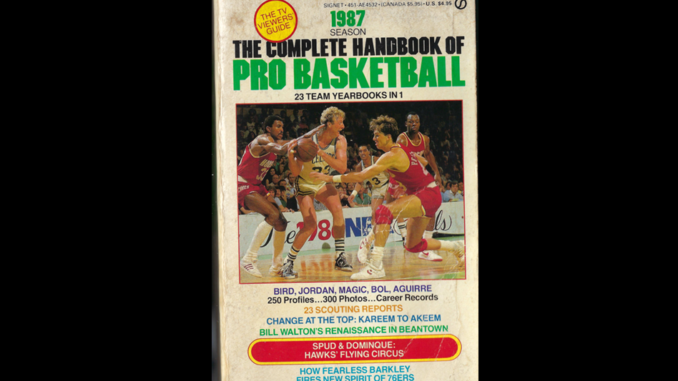
Before the internet, in the 1970’s, 1980’s, and 1990’s — as a basketball fan I couldn’t wait each October for the Zander Hollander Complete Handbook of NBA Basketball to be published and be available in bookstores.
I’d check the bookstores weekly until it arrived. Seeing it on the shelf was a special, magical treat — I’d purchase it with zest and start reading it on the subway home. Hollander provided funny and accurate bios and a scouting report of each player. He was a comedian and excellent basketball analyst — like any good comedian he hit the nail on the head.
He also provided statistics for each player, a scouting report on players just drafted, and predictions — a complete handbook.
Analysis of Zander’s Knick Analysis
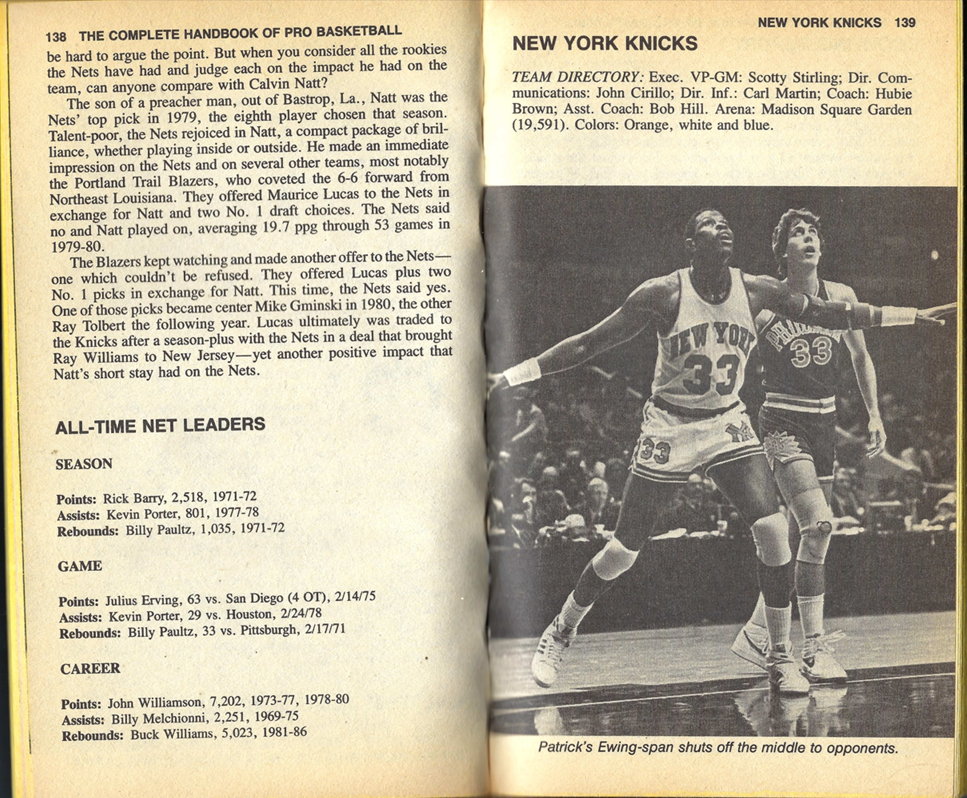
I’m posting a sampling of the 1987 Handbook — the pages for the Knicks team — under Fair Use doctrine of Copyright law, and with perfect hindsight, will analyze Zander’s analysis. The 1987 handbook covered the 1985-86 season just completed, the draft, and predictions for 1986-87.
Reprint provided under Fair Use doctrine of Copyright law.
Shooting, Playmaking, Rebounding, Defense & Outlook
Note Hollander broke Offense down into shooting and playmaking.
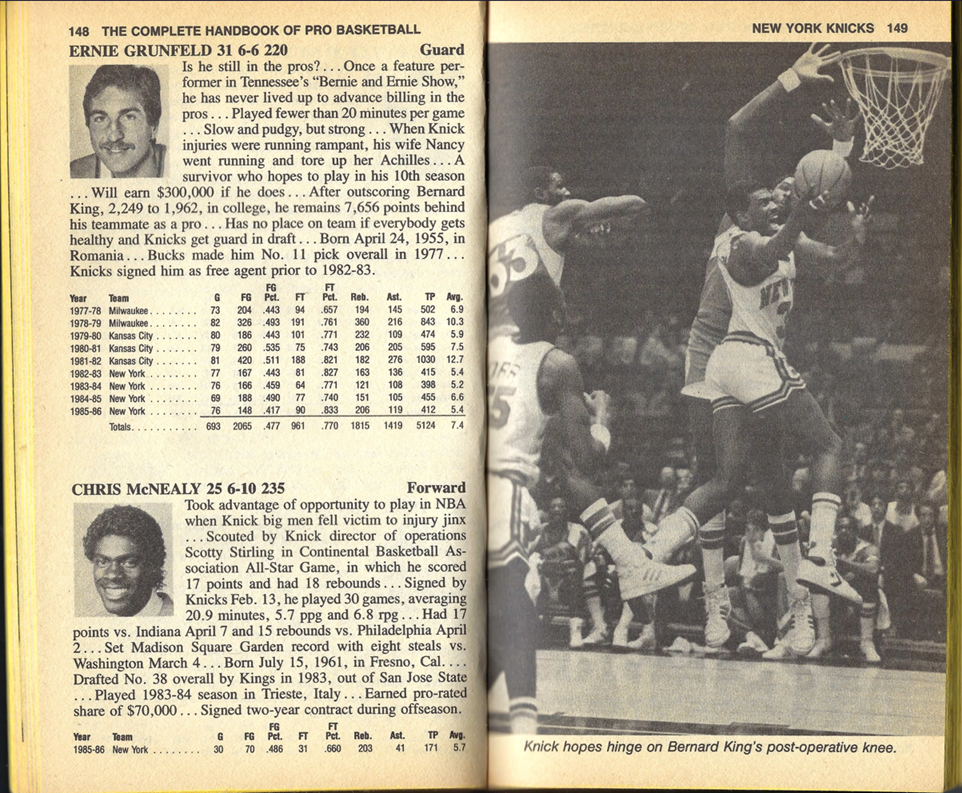
The 1985-86 Knicks were still reeling from devastating injuries incurred the year before — to Bernard King and Bill Cartwright amongst others (Leonard “Truck” Robinson, etc) — which had allowed them to get the #1 pick in the draft and land Patrick Ewing. But the Knicks were still reeling from injuries during Patrick’s rookie season — with King and Cartwright still out — and even Ewing missed 30 games.
Hubie Brown was the coach and he stressed Defense — so the Knicks had that going for them; but some of that, as Hollander pointed out, was “using the shot clock as much as possible on every possession” to slow down the game.
The Knicks were full of question marks — based on the returns of Bernard King and Cartwright and how well they would play. Hollander predicts “The Knicks can make a marked turnaround or stay right where they were, at 23-59. It all depends on who comes back.”
And Zander nailed it — NY went 24-58 in 1986-87. Bernard King only came back at the very end of 1986-87, playing 6 games. Bill Cartwright still missed game recuperating — playing 58 games and was pretty good in those games, averaging 17.1 ppg. Kenny Walker was ok as a rookie — averaging 10.1 ppg — but evidence was already mounting he had no shot — like the James Worthy they thought he might become.
Reprint provided under Fair Use doctrine of Copyright law.
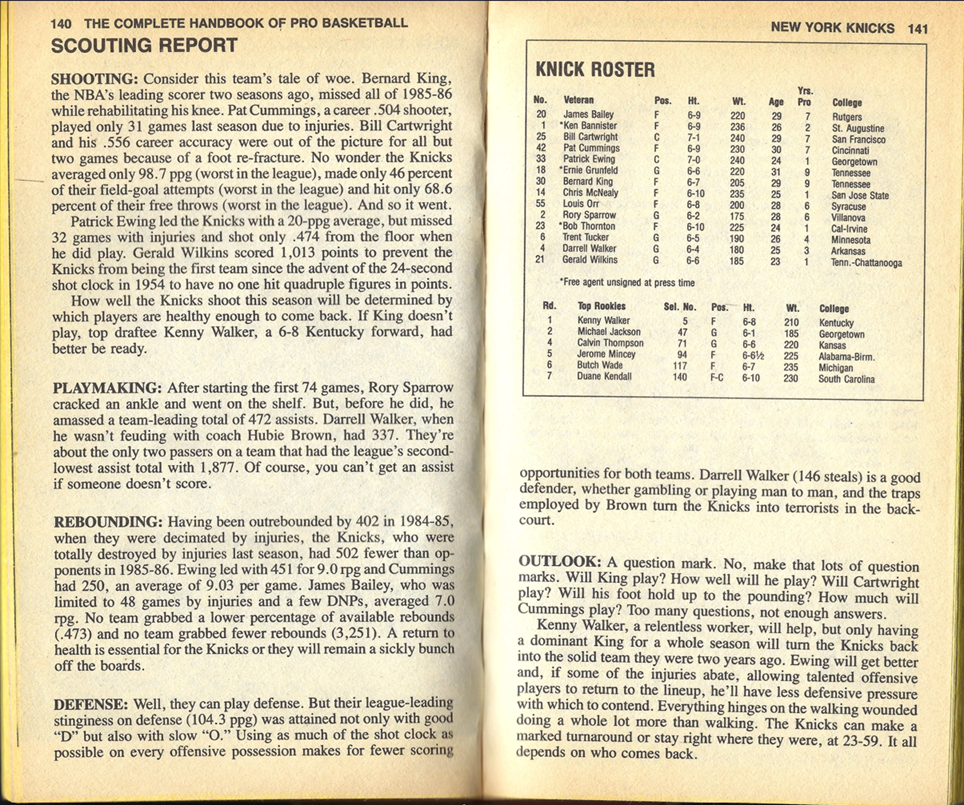
On Bernard King
“His career remains in jeopardy,” starts Zander. And King would miss most of the upcoming season as well. Then the Knicks gave up on him — and he signed as a free agent with Washington of 1987-88 where he did regain his prowess as a star scoring forward, having 4 strong seasons there and making the All Star team in 1990-91 — until he blew out his knee again at age 34.
Reprint provided under Fair Use doctrine of Copyright law.
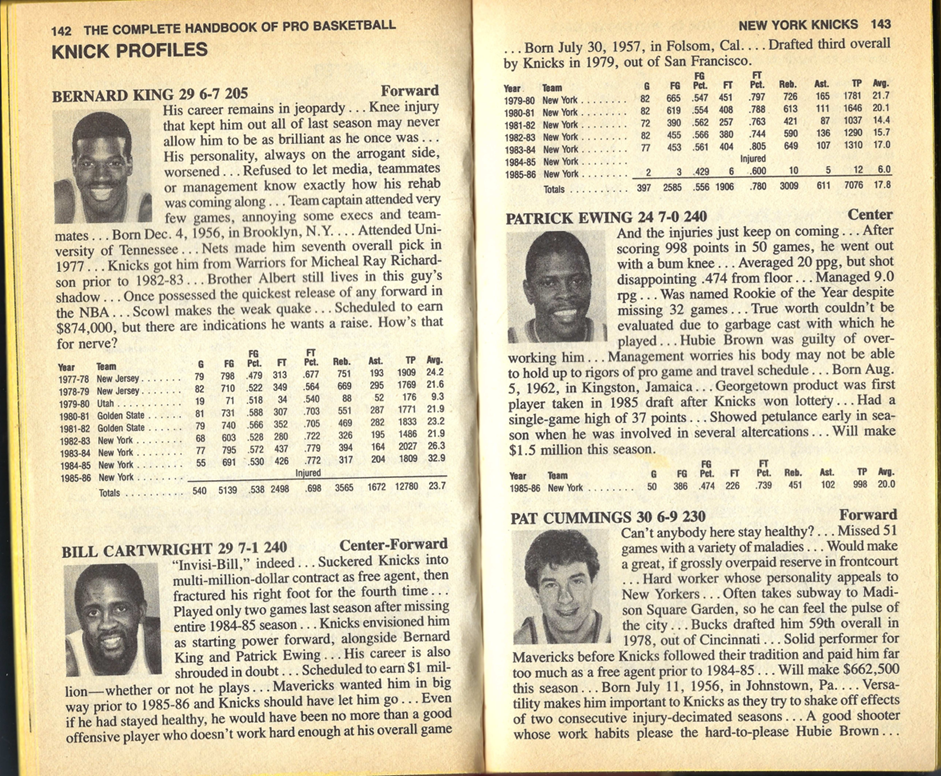
On Ewing
“Management worries his body may not be able to hold up to rigors of pro game and travel schedule” — yowsa was management wrong! NBA analysts and management were not fully sold on Patrick’s game in his first few seasons; it wasn’t until Mark Jackson came along and stated Ewing was the best center in the NBA and started feeding him the ball that Ewing reached his Hall of Fame prominence — and that didn’t happen until 1987-88.
On Darrell Walker
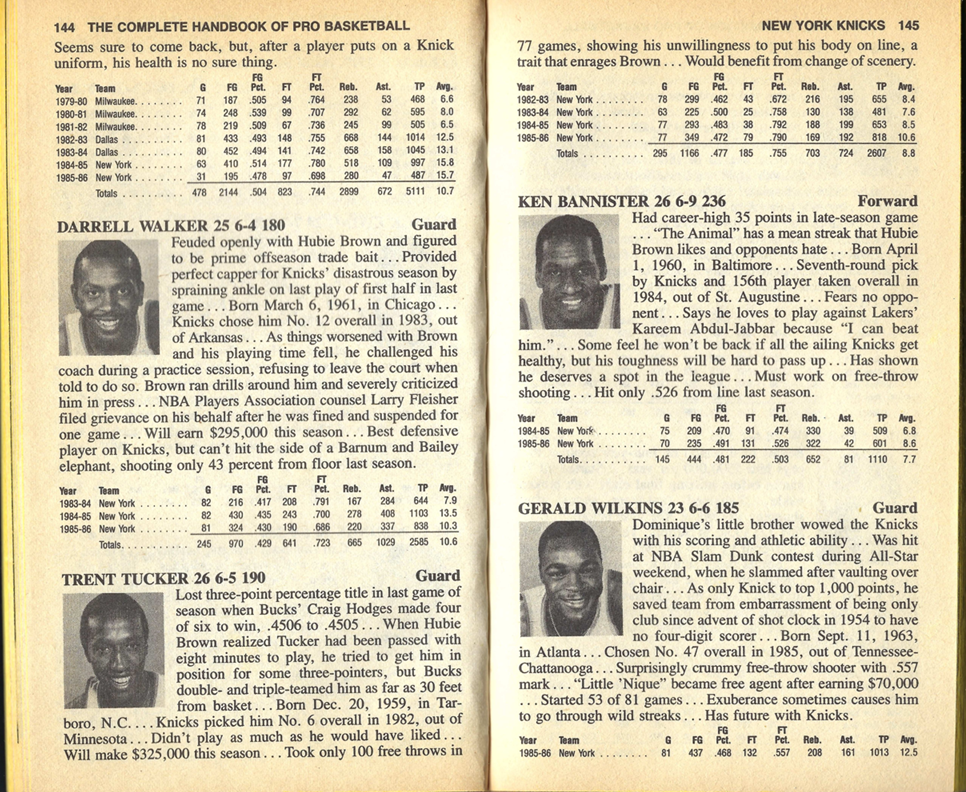
Darrell Walker had been a top draft pick — #12 overall in the 1983 draft. He could play D — but his offense was lacking. Watching the Knicks every game back then, and reading about them in the papers every day — I still did not know how badly coach Hubie Brown and Darrell Walker disagreed. Zander nails it when he writes “Feuded openly with Hubie Brown and figured to be prime offseason trade bait.” Indeed, on October 2, 1986 — just before the 1986-87 season began and long after the publishing of the Hollander book — Darrell Walker was traded by the Knicks to the Denver Nuggets for a 1987 1st round draft pick (Olden Polynice was later selected).
On Tucker
Like Darrell Walker, Trent Tucker was a high draft pick by the Knicks — selected #6 overall in 1982. The Knicks hoped he would be the next Sidney Moncrief — a dynamite 2-way guard. The 6’5 Tucker could Defend and hit the 3 — a 3-and-D guard — but he did not go to the basket much — which made him a good reserve guard but major disappointment to Knick fans who wanted a top-of-league All Star. Hollander points this out, “Took only 100 free throws in 77 games, showing his unwillingness to put his body on line, a trait that enrages Brown. Could benefit from a change of scenery.”
Tucker wouldn’t be traded — he’d play an important role as a 3-and-D guard off the bench for NY — through Rick Pitino’s Bomb Squad team and the post-Pitino Stu Jackson Knicks — until finally being traded as soon as Pat Riley came to town — part of a package for Xavier McDaniel just before the 1991-92 season.
Gerald Wilkins & The Animal
This year’s write up featured Ken Bannister — “The Animal” — one of the great Knicks during hard times. And the young Gerald Wilkins, who was a star for the Knicks in the upcoming Rick Pitino era.
Orr and Sparrow
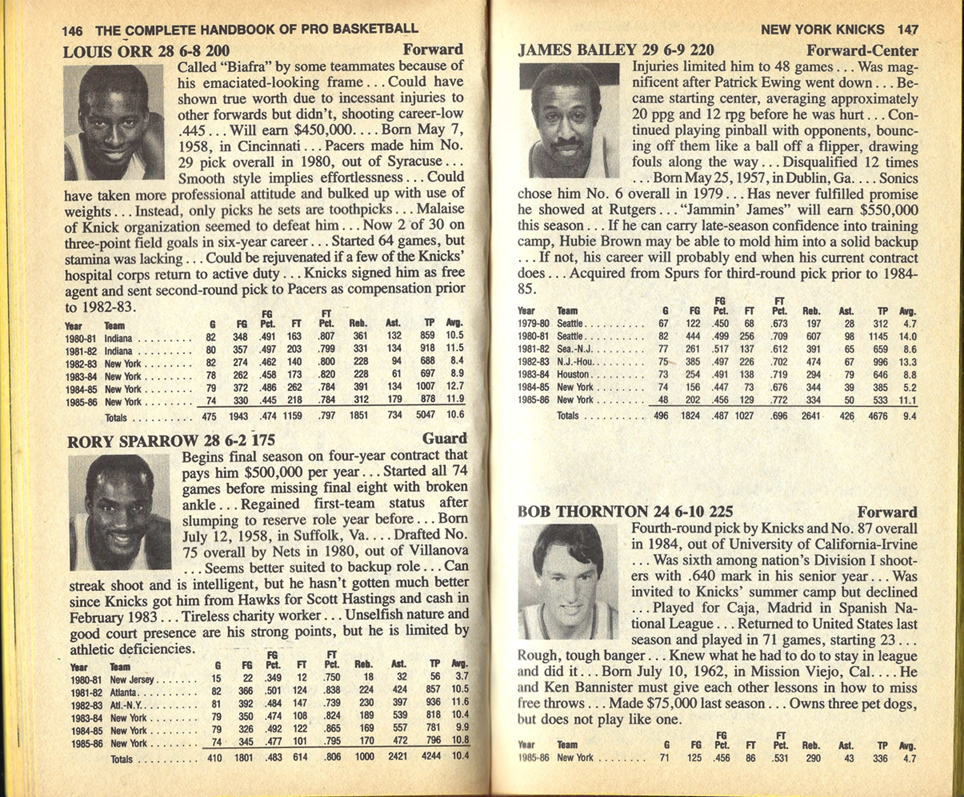
Louis Orr was a great pickup by the Knicks and provided several seasons of silky-smooth offense. But he was super skinny and that kept him as a reserve sort. Hollander puts it bluntly: “Could have taken more professional attitude and bulked up with the use of weights.. Instead, the only picks he sets are toothpicks.”
Rory Sparrow was the ultimate Knick of the era — good, but not great.
On James Bailey
It is easy to forget that James Bailey had such a great season for the 1985-86 Knicks — as Hollander points out. “Was magnificent after Patrick Ewing went out. Became the starting center, averaging approximately 20 ppg and 12 rpg before he was hurt.” Bailey averaged 11.1 ppg for those Knicks — and had seasons of 14 ppg and 13 ppg in his career. When he came out of Rutgers the thought was he’d be an NBA All Star — he was the #6 overall pick in the 1979 draft.
On Kenny Walker
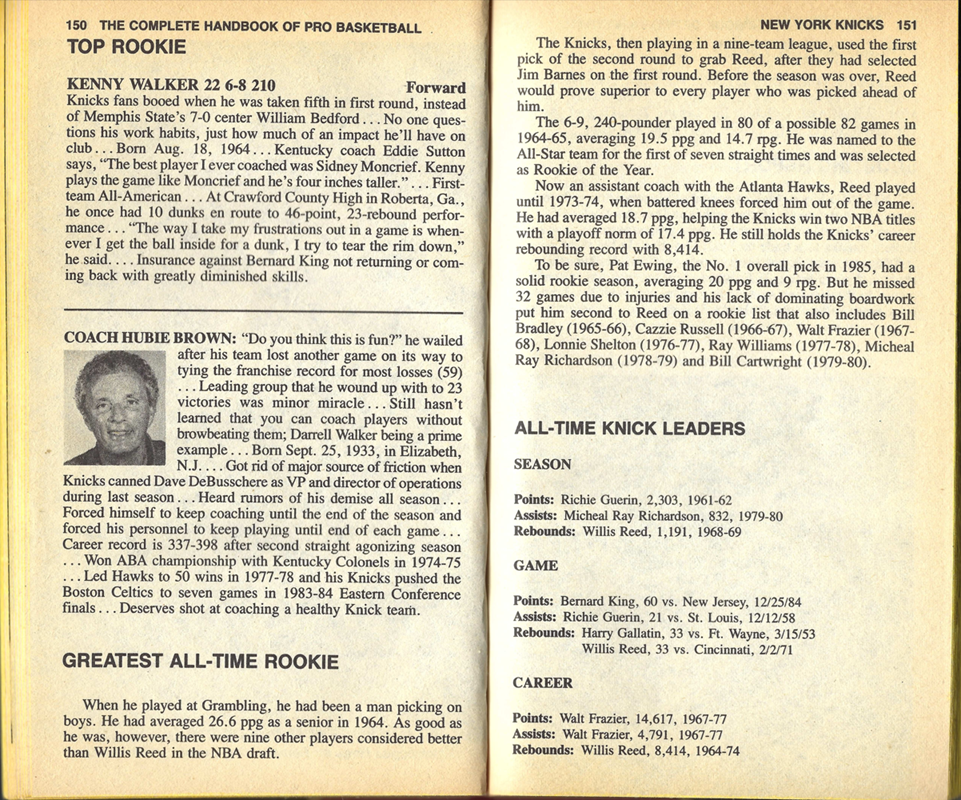
“Knick fans booed when he was taken fifth in first round, instead of Memphis State’s 7-0 center William Bedford,” writes Zander on Kenny Walker. (Knick fans also wanted NY to pick local hero Walter Berry out of St John’s, who went #14.)
Knick fans were right to boo — as Kenny Walker would never be the James Worthy -esq player the Knicks were hoping he’d be. But William Bedford had a disappointing career as well — Walker was the better pick over Bedford. It was a weak draft and a decisive pick for NY — their chance to draft a star player to go alongside Ewing.
The best players in the 1986 draft were Ron Harper (#8), and Arvydas Sabonis (#24), and 2nd rounders Mark Price (#25) and Dennis Rodman (#26).
The very next year, Chicago drafted Scottie Pippen at #5 in a deeper draft.
On Coach Hubie Brown
“Heard rumors of his demise all season,” wrote Zander. “Still hasn’t learned that you can coach players without berating them.”
And again Zander nailed it — Hubie Brown was fired after a 4-12 start to the 1986-87 season, replaced by Bob Hill (who went 20-46). Rick Pitino would be hired for 1987-88 and the fun era of the Bomb Squad would begin.
On Zander Hollander
Zander Hollander passed away in 2014. He created something special, and his handbooks will live on for many years; each one a treasure.
Comments? Feedback?
Please post below.
Be the first to comment