
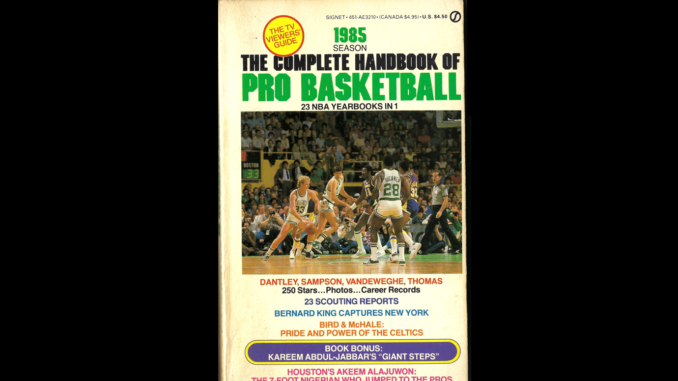
Back in the days before the internet, I cannot tell you how thrilling it was to approach October, the start of the new NBA season, when the new Zander Hollander Complete Handbook of Pro Basketball would come out.
You’d keep checking in the Sports section of the bookstore — which for me was a Barnes & Nobles in Manhattan on 6th Avenue and 8th Street — to see if it had arrived.
And then there it would be — a quick purchase and could not wait to start reading it on the subway home to Brooklyn.
Zander Was On Point & Funny
It was more than a treat — the unique feature was the funny and accurate bios of each player that Hollander provided, which were part scouting report, part standup comedy, but always razor sharp and on the money. Zander pushed the envelope. This type of writing, on sports players, was not available anywhere.
Zander also provided statistics for each player, a scouting report on players just drafted, and predictions — a complete handbook.
Analysis of Zander’s Analysis
I’m providing here a sampling of the 1985 Handbook. I’m presenting the pages for the Knicks team — under Fair Use doctrine of Copyright law, and with perfect hindsight, will analyze Zander’s analysis. The book details the 1983-84 season, with the 1984-85 season about to begin.
The 1983-84 Knicks
The Knicks were coming off a wild season — the height of the Bernard King era — when Bernard led them to 47 wins in the regular season, an amazing win over Isiah Thomas and Detroit 3 games to 2 in the 1st round, and then a loss in 7 games to Larry Bird and the Boston Celtics in the Eastern Conference Semi Finals. Boston would go on to win the NBA title.
This was a Knick team that rose from the ashes of the 1981-82 Knicks — who fell to 33-49 after going 50-32 in 1980-81 — with Bill Cartwright‘s and Michael Ray Richardson leading them. But then came drugs and — we would learn years later — FBI investigations of game fixing. NY traded Maurice Lucas for Leonard “Truck” Robinson and Michael Ray Richardson for Bernard King, and replaced coach Red Holzman with Hubie Brown and the Knicks took off.
Hubie Brown was a defensive guru. Offensively, Bernard King pushed away the alcohol issues he had in Golden State and raised his game to new levels, becoming one of the elite scorers in the NBA. He averaged 26.3 ppg in 1983-84.
Zander nails it on Bernard King’s efficiency as a scorer: “Bernard doesn’t force the drive or pull up for the shot when he doesn’t have an opening. His remarkable 57.2 percent field-goal average attests to that.”
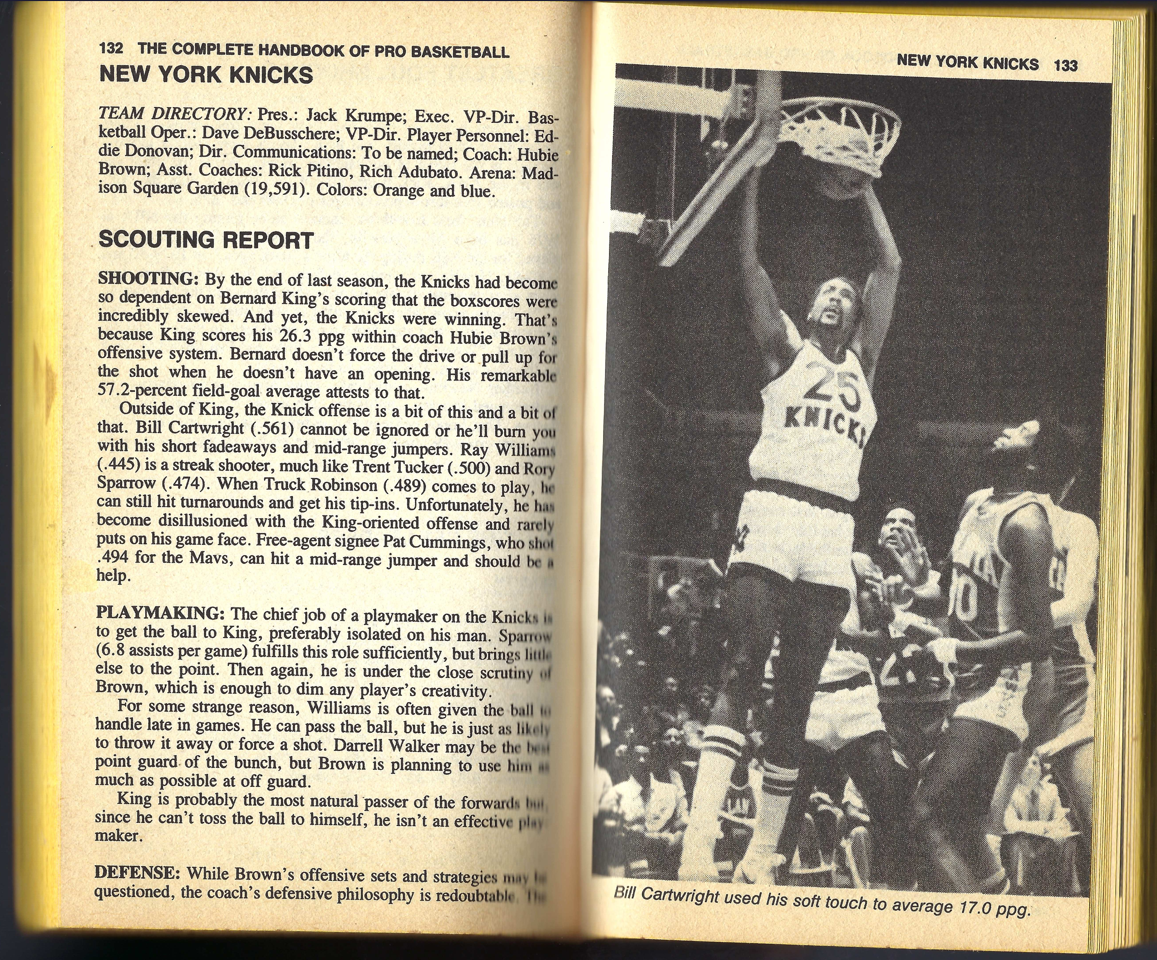
And then a Zander zinger: “King is probably the most natural passer of the forwards but since he can’t toss the ball to himself, he isn’t an effective playmaker.”
NY had Rory Sparrow at the point, Ray Williams, Darrell Walker and Trent Tucker as shooting guards, Bill Cartwright at center, and Truck Robinson at the power forward.
On Hubie Brown: “Brown’s teams can get away with pressing so hard for so long because the coach uses two complete units to give his players adequate rest.”
The Power Forward Position
Zander didn’t see the Knicks rising above Boston — “The Knicks are a team with a great deal of potential, because they would be so tremendously improved with the addition of that elusive power forward.”
That’s an interesting statement because NY had one of the elite power forwards in the game in Maurice Lucas whom they traded after 1 season for Truck Robinson — which was a head-scratcher at the time. Thirty years later the possible reason became clear when it came out that the FBI was investigating those Knicks for drug use and game fixing.
Zander’s Prediction for 1984-85
Zander states “There have been few changes” and predicts “The Knicks should finish third or fourth in the Atlantic division.” He was right about the Knicks having a team that was not going to improve. He could not have predicted the slew of injuries that decimated the 1984-85 Knicks — with Bill Cartwright going down, and Truck Robinson, and then finally Bernard King with the horrific ACL injury midway thru a year when he was leading the league in scoring. NY would spin out to a 24-58 record — which ended up being a great thing as it caused them to get the #1 pick in the draft and Patrick Ewing.
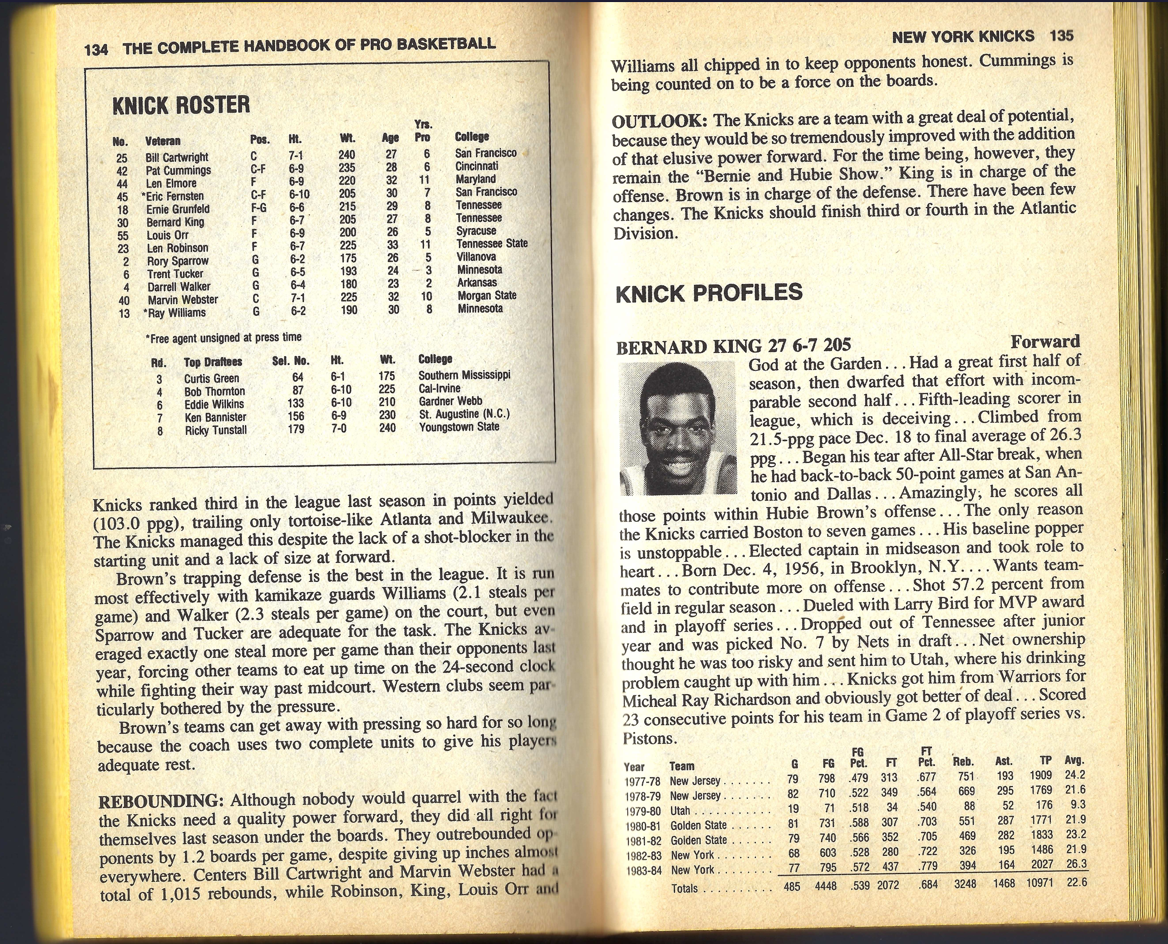
Bernard King was fresh off his rise-to-stardom campaign, as Zander puts it: “Had a great first half of season, then dwarfed that effort with an incomparable second half.”
Zander mentions Bernard King’s drinking problem, when referencing how the NY Nets drafted him, but “Nets ownership thought he was too risky and sent him to Utah, where his ddrinking problem caught up with him.”
On Bill Cartwright: “Dubbed “Invisi-Bill” because of his reluctance to take ball to hoop. USF grad still prefers to pull up for five-foot pop instead of going over opponent and drawing a foul.” Bill would suffer a devastating foot injury in the season to come — then play twin towers with Patrick Ewing for a few years before being traded to Chicago for Charles Oakley, a great trade for NY, and not a bad one for Chicago as Bill improved his defense there and his inside game. But that was years in the future.
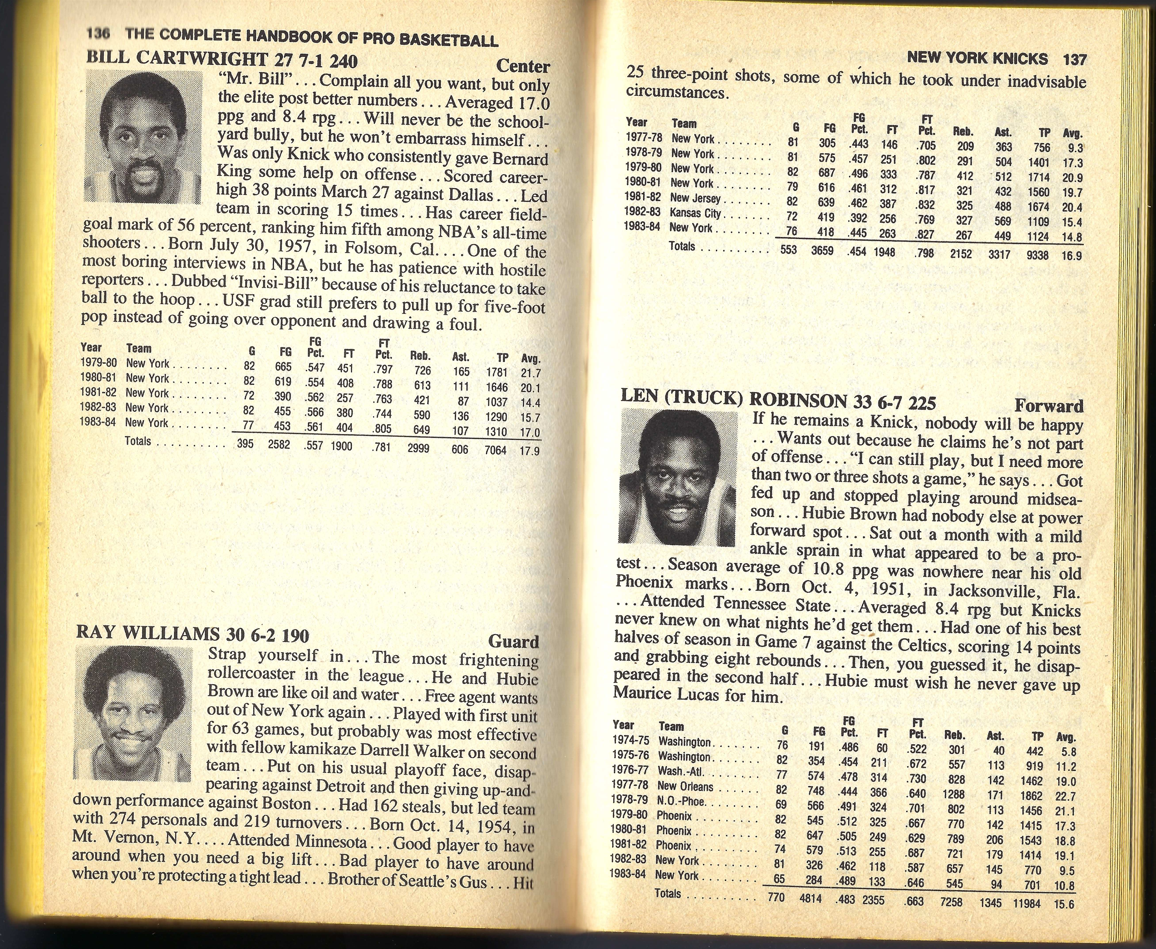
On Ray Williams, it was pure Zander: “Strap yourself in.. The most frightening rollercoaster in the league.”
On Truck Robinson: “If he remains a Knick, nobody will be happy. Wants out because he claims he’s not part of the offense. “I can still play, but I need more than two or three shots a game.” Can you imagine the lockerroom with this guy around. “Sat out a month with a mild ankle sprain in what appeared to be a protest.”
Zander didn’t have a lot of high praise for Rory Sparrow, “Most overpaid player in league.” Sparrow had been given that contract after the Knicks tried to sign Kevin McHale in 1983 as a free agent, but McHale used them — re-signing instead with Boston, and Red Auerbach got revenge on the Knicks by signing three Knicks — Sparrow, Marvin Webster, and Sly Williams — to large contracts that the Knicks felt they needed to match or lose a third of their team.
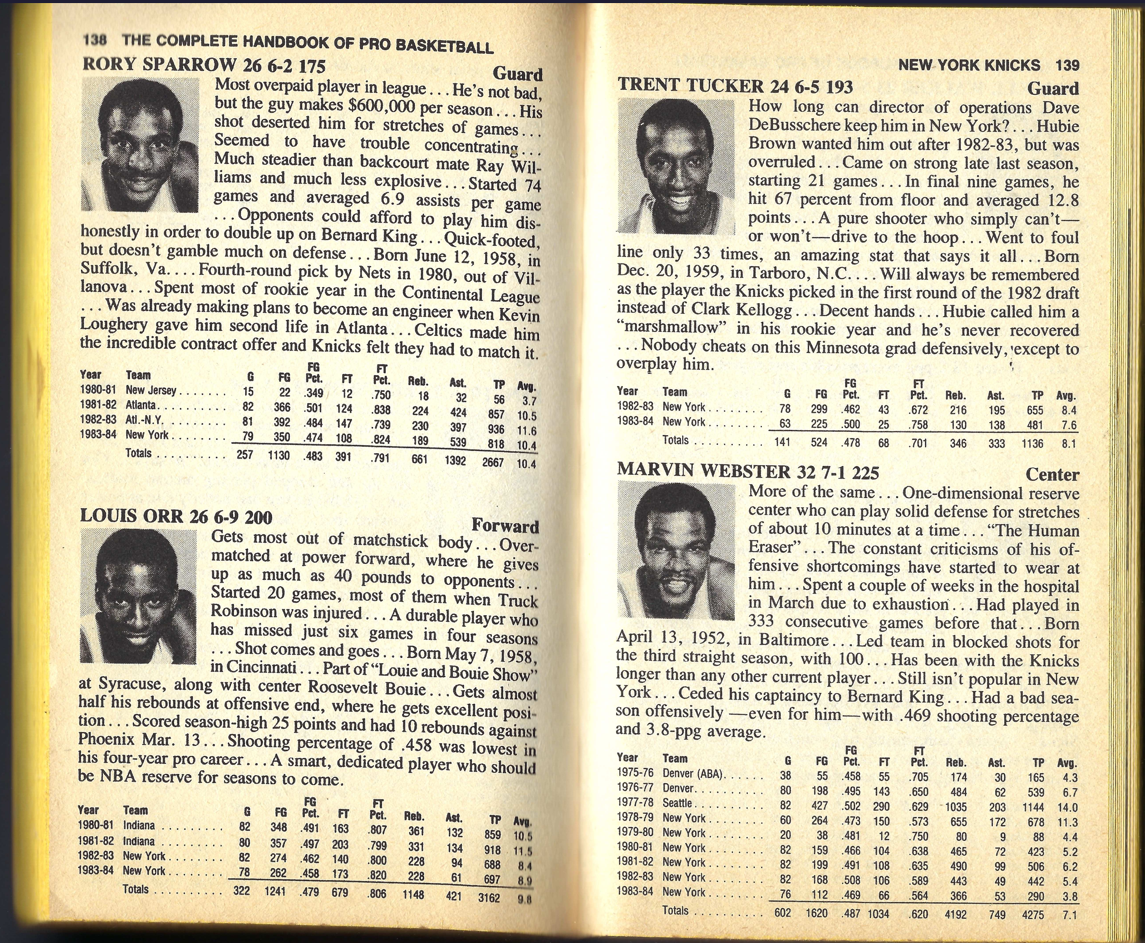
Zander pegged Louis Orr as “A smart, dedicated player who should be NBA reserve for seasons to come” but had less praise for Trent Tucker, about whom he asked “How long can director of operations Dave DeBusschere keep him in NY?” Tucker had been a major disappointment after being drafted by the Knicks with the #6 pick in the draft in 1982. NY thought they would be getting the next Sidney Moncrief — a great all-around shooting guard. But Tucker was “A pure shooter who simply can’t — or won’t — drive to the hoop.”
Zander nailed it — as a Knick fan of that era, Tucker’s inability to drive to the hoop was beyond frustrating.
On Marvin Webster, Zander didn’t pull punches: “More of the same. One-dimensional reserve center who can play solid defense for stretches of about 10 minutes at a time.”
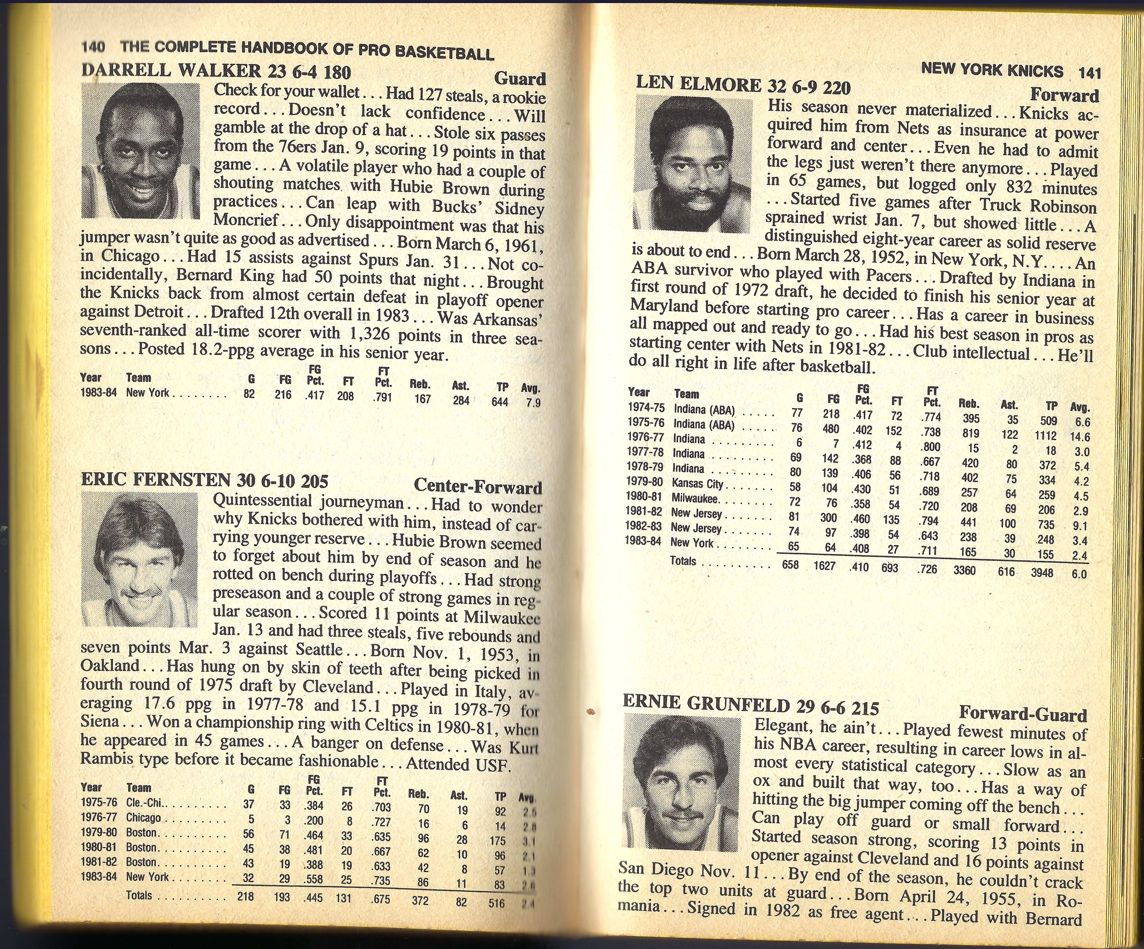
What a great Zander opening line for Darrell Walker: “Check your wallet… Had 127 steals, a rookie record.”
On Eric Fernsten: “Quintessential journeyman.. Had to wonder why Knicks bothered with him, instead of carrying younger reserve.” On Len Elmore: “Has a career in business all mapped out and ready to go.”
On Ernie Grunfeld: “Slow as an ox, and built that way too.” “Sneaked into 76 games.”
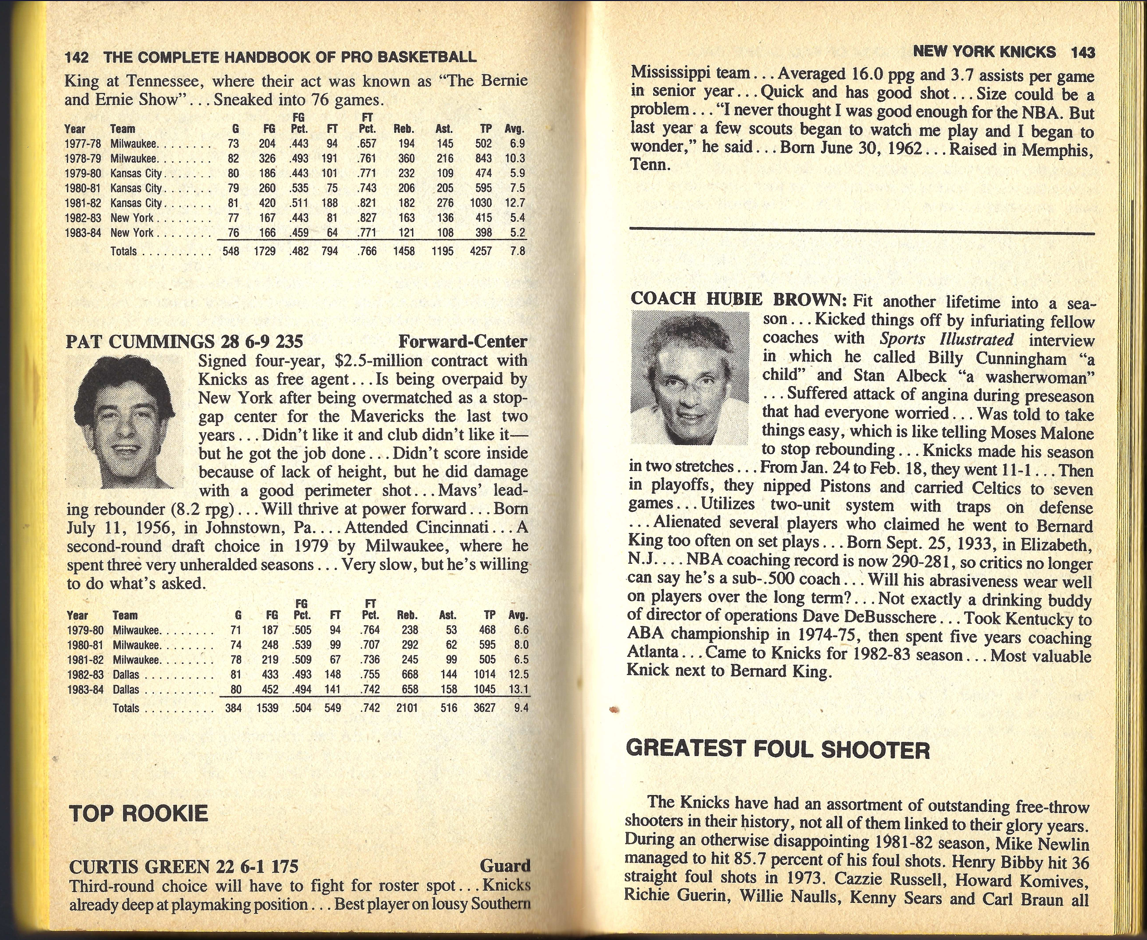
Zander didn’t think the Pat Cummings signing would be a great one for NY: “Is being overpaid by New York after being overmatched as a stop-gap center for the Mavericks the last two years. Didn’t like it and club didn’t like it — but he got the job done.”
Interesting bit on Hubie Brown: “Suffered attack of angina during preseason that had everyone worried. Was told to take it easy which is like telling Moses Malone to stop rebounding.”
Hubie was 50 years old at the time, and here we are 50 years later at this writing — and Hubie Brown is still going strong at 92 years old, having just retired from this Hall of Fame career as a national broadcaster.
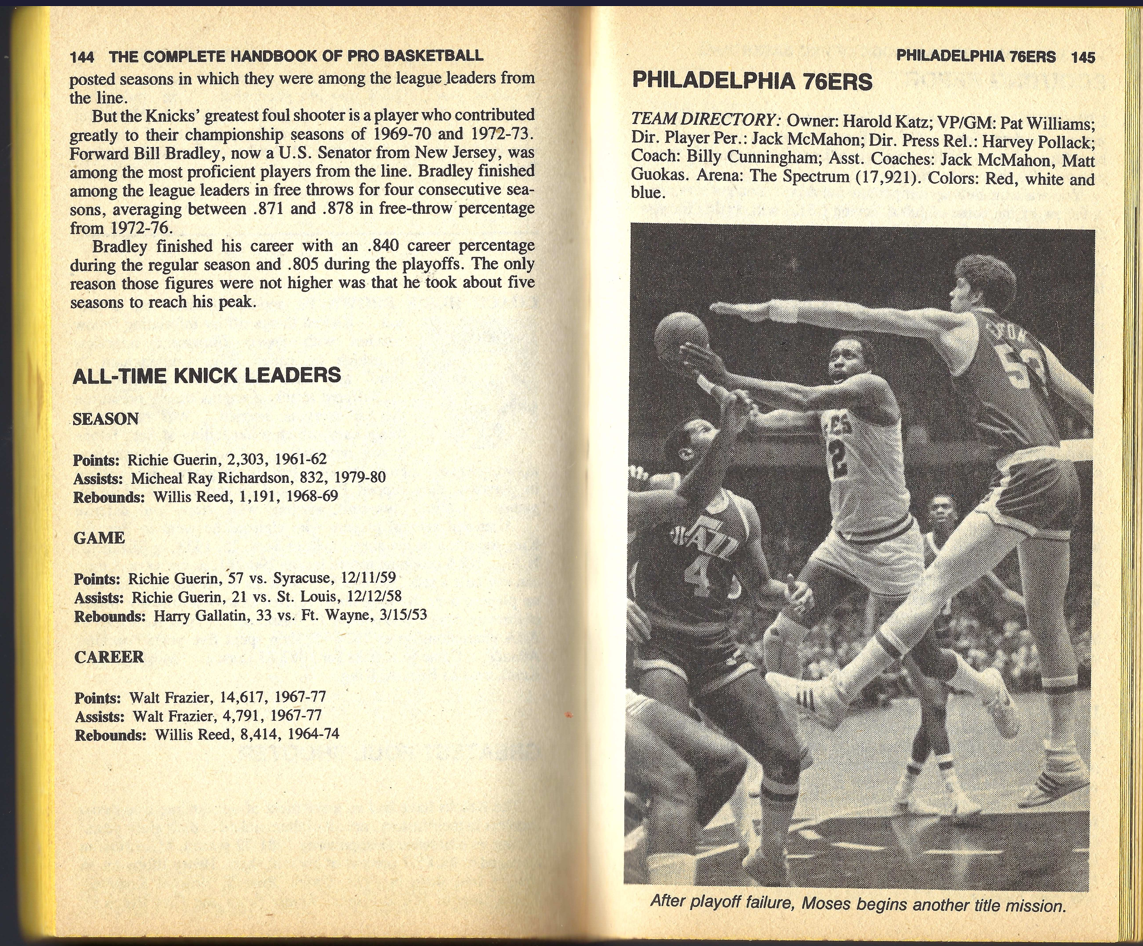
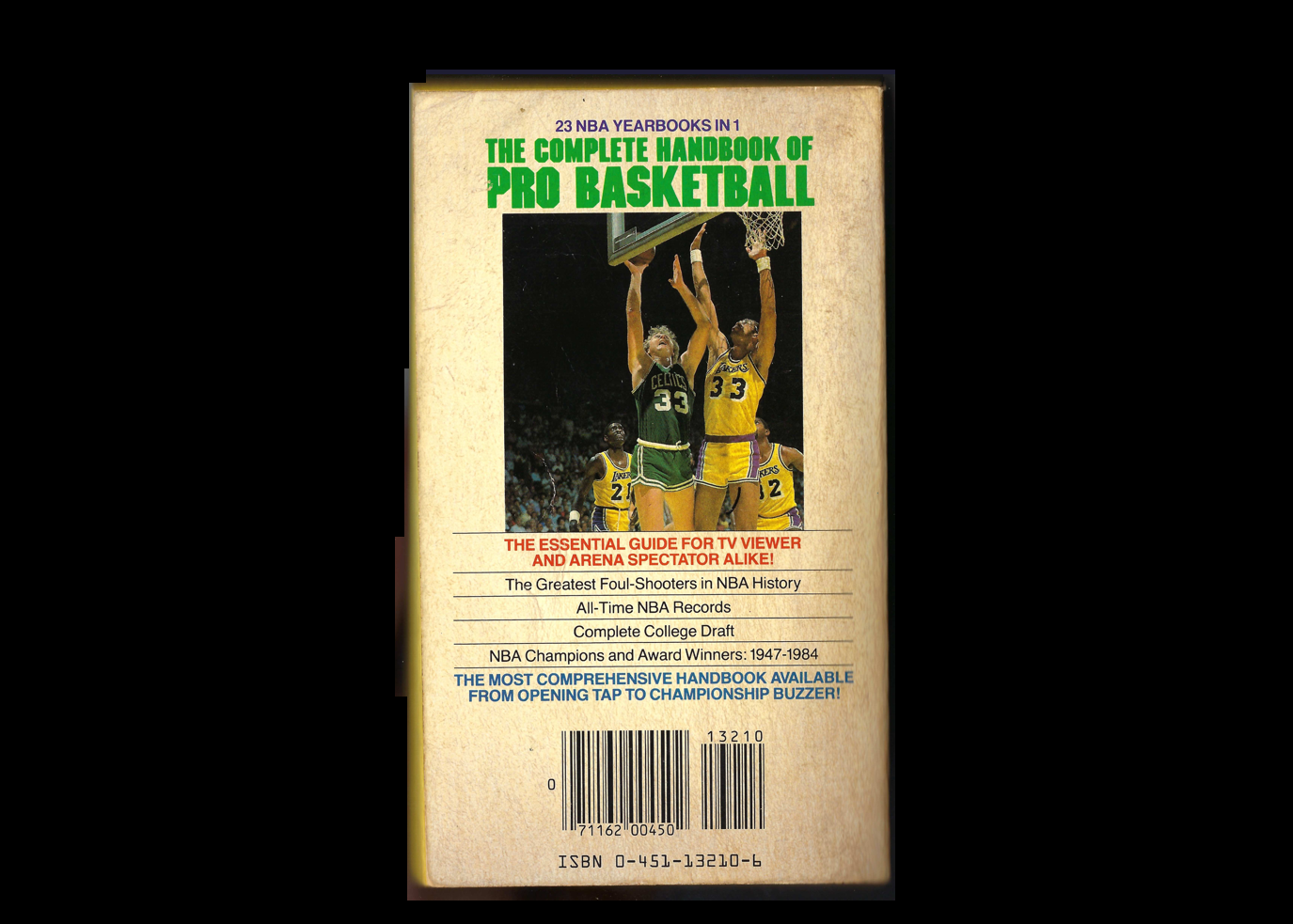
Larry Bird graced the front cover and the back cover of the 1985 Handbook, in pictures of the NBA finals against the Lakers and Kareem Abdul-Jabbar and Magic Johnson.
Be the first to comment